
Managing individual logins and repeatedly verifying identity across dozens of web applications can make onboarding slow and frustrating.Platforms must balance proper user verification with maintaining a smooth access experience.
Traditional identity systems typically require each platform to collect and store copies of government IDs, selfies, or other sensitive data. Every additional copy expands the potential attack surface and increases compliance and data protection responsibilities.
Age App’s reusable digital identity model aims to reduce repeated document uploads while still requiring real-time, session-based verification whenever access is requested. For web applications, this approach supports strong verification standards without unnecessarily increasing friction or duplicating sensitive identity data across systems.
What Does a Reusable Digital Identity Mean?
A reusable digital identity refers to a verification model that allows individuals to access multiple services without repeating a full identity check each time.
Age App’s model is a cryptographically protected verification result that enables platforms to confirm required attributes without repeatedly collecting identity documents, while still enforcing live, session-based verification when access is requested.
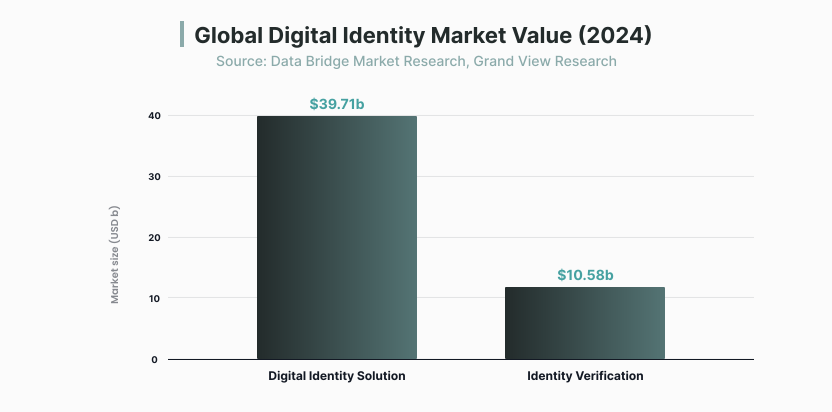
In 2024, the global digital identity solution market reached about 39.71 billion USD, highlighting the growing demand for secure and efficient verification methods. As demand for secure and efficient verification grows globally, reusable models are gaining attention as a way to balance user experience with stronger data protection practices.
Under this approach, an individual completes an initial identity verification step, such as validating a government ID with biometric matching, which establishes a secure eligibility baseline. When a web application later needs to confirm an attribute like “Is this user over 18?”, the user completes a live verification session instead of re-uploading identity documents.
Problems With Traditional Identity Verification
Traditional identity verification tools typically require users to upload documents and selfies separately for each platform, increasing onboarding friction and repetition.
As digital services expand globally, individuals are often required to verify their identity across multiple applications. Each verification can result in new copies of sensitive documents being stored in separate systems, expanding the potential exposure if a platform experiences a breach.
Simultaneously synthetic identities and deepfake-enabled impersonations make it increasingly difficult to rely solely on static document images distributed across databases.
For web applications, manual document reviews and fragmented verification workflows are difficult to scale under growing regulatory pressure, resulting in slow onboarding, increased operational costs, and inconsistent user experiences.
Reusable Digital Identity vs. Traditional Identity Verification
Age App’s Reusable identity allows a web application to confirm required attributes without collecting or storing full identity artifacts.
| Aspect | Traditional Verification | Reusable Digital Identity |
|---|---|---|
| Verification pattern | Users repeat full ID checks on each platform | Users complete an initial setup, and perform live, session-based verification for each access request. |
| Data shared | Raw ID documents, selfies, personal details | Time-limited, cryptographically signed pass/fail age-eligibility results |
| Data Storage | Each platform stores identity documents and related data | Platforms receive time-limited verification results per session without receiving ID images or biometric artifacts. |
| User effort | High friction, repeated uploads across services | Low friction after initial setup |
| Privacy posture | Broad data collection, larger breach exposure | Data minimization with session-based result delivery |
The platform validates a cryptographically signed verification result generated during a live session, rather than relying on stored document copies.
How Reusable Identities Work with Age App in Web Applications
Initial Checking Using Authoritative Data
A user completes a structured identity or age verification process that includes validating a government-issued document and performing a live biometric match.
This process involves advanced identity verification tools with KYC methods, including document authenticity checks, security feature validation, and facial matching to confirm that the person presenting the document is the rightful holder
Generation of Cryptographically Signed Verification Result
Once verified, Age App generates a time-limited, cryptographically signed age-eligibility result for the current session.
This result allows platforms to confirm that a user meets the required age threshold without receiving ID images, biometric data, or identity details.
Fast Age Verification Across Web Apps Without Re-Uploading IDs
When the user visits a web application that requires age confirmation, the platform requests verification of a – “Is the user 18+?”
Age App conducts a live verification session and generates a signed age-eligibility result for that session. The web application validates the result in real time through secure verification flows, without receiving identity documents, images, biometric artifacts or unnecessary personal data.
Explore Related Topic
Ultimate Guide to How Online Age Verification Works
Role of Verifiable Results in Reusable Identity
Verification results are digitally signed statements about a specific attribute, such as whether a user meets an age threshold, that can be cryptographically validated by a web application during a verification session. These results are generated only after the system verifies the user, without exposing full identity details to the platform.
These verification results allow privacy-first validation. A platform can confirm a statement such as “over 18” without receiving the user’s birth date, document images, or other sensitive personal identity information.
This enables web applications to make strong access decisions while limiting the amount of personal data collected and stored.
Because verification results follow standardized validation methods, they can be consistently verified across different platforms and web applications, helping with interoperability .
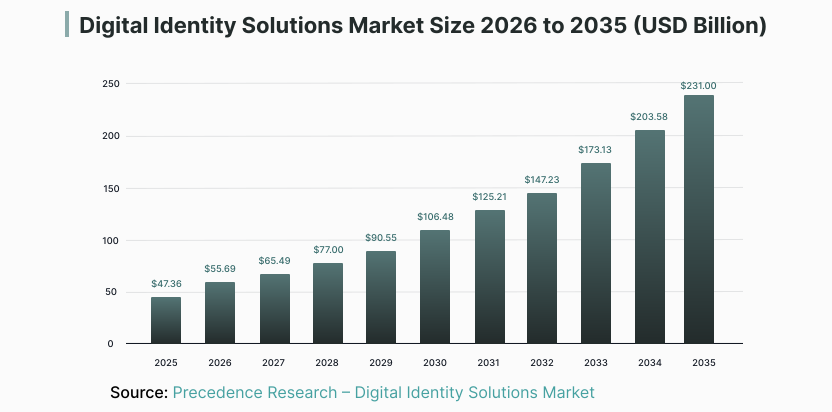
The digital identity solutions market is valued at approximately USD 47.36 billion in 2025 and is projected to grow to USD 203.58 billion by 2035 at a 17.59% CAGR, reflecting rapid adoption of reusable digital identity and privacy-first verification models globally. As digital services continue to expand, privacy-first verification models are gaining attention as a way to strengthen compliance while reducing unnecessary identity data exposure.
Age App: User Control, Privacy, and Data Minimization
With Age App, users complete verification when age confirmation is required, and age eligibility is enforced through live, session-based checks each time access is requested.
Web applications receive only a signed age-eligibility result, such as pass or fail, rather than raw identity artifacts or document images.
This approach aligns with privacy-by-design principles and evolving policies focusing on purpose limitation, data minimization, and user agency.
By reducing the need for platforms to store replicated copies of identity documents and biometric images, Age App’s reusable verification model helps limit unnecessary data exposure and reduce the overall identity storage footprint across systems.
“Privacy by design calls for privacy to be taken into account throughout the whole engineering process.” — Ann Cavoukian
Benefits of Reusable Digital Identity
Reusable digital identity strengthens privacy, security, and compliance across every verification flow. Here’s how it delivers measurable advantages for both users and web applications.
For Users
- Quickly access web applications through a streamlined workflow after completing initial eligibility setup.
- Reduce the need to repeatedly upload identity documents across platforms.
- Limit exposure of personal information, since platforms receive only required verification results.
For Web Applications
- Streamline onboarding flows with reduced document repetition and user abandonment.
- Reduce fraud through cryptographically signed, session-based verification results.
- Limit compliance and regulation risks by receiving only a session-based yes/no age-eligibility result and not sharing or storing government ID images or biometric artifacts.
Common Use Cases for Reusable Digital Identity
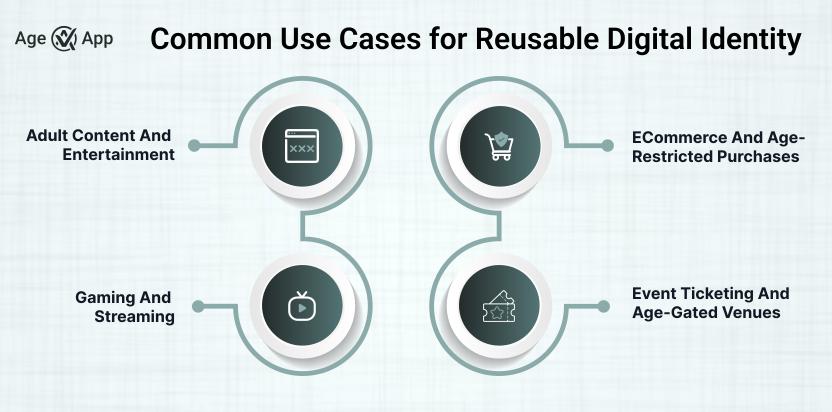
Reusable digital identity enables fast, privacy-first age verification without repeated ID uploads. Here are common use cases where you can use it to simplify age-gated access across industries.
-
- Adult Content and Entertainment: Platforms that restrict access based on age can enforce privacy-preserving age verification without requiring repeated ID uploads.
- Gaming and Streaming: Online gaming and streaming platforms can confirm age eligibility for regulated features while maintaining streamlined access across devices.
- eCommerce and Age-restricted Purchases: Online and in-person retailers selling alcohol, tobacco or cannabis, or other regulated products can utilize session-based age verification at entry or checkout without relying on manual entry handling, collecting or storing government ID images.
- Event Ticketing and Age-Gated Venues: Digital ticketing platforms can confirm age thresholds before granting access to age-restricted events or services.
Technical Considerations for Implementing Age App’s Reusable Identity
- Interoperability: Reusable identity is most effective when built on standardized API-based verification flows that allow platforms to validate signed verification results in real time. Consistent validation methods ensure that verification results can be validated consistently across different web applications.
- Cryptographic Security: Verification results should be digitally signed using strong cryptographic methods. Platforms must be able to validate these signatures securely to confirm authenticity and prevent tampering.
- Regulatory and Privacy Safeguards: Implementation should align with applicable privacy regulations such as GDPR, national and state-level identity or age-verification laws. This includes clear consent mechanisms, defined data use purposes, and limited data retention practices.
- Scalability: Verification systems must be able to handle high request volumes with low latency, especially for consumer-facing platforms operating across regions and time zones.
Age-based solutions can be integrated through SDKs or APIs, allowing platforms to trigger verification flows and validate session-based age results without directly handling identity documents or biometric artifacts.
[age_app_blog_cta button_target=”1″ heading=”Upgrade Age Gates with Reusable Age Tokens” description=”Replace repeated document uploads with real-time, signed age verification designed for scalable web applications.” button_text=”Modernize Age Verification” button_url=”https://share.hsforms.com/1bw6ZG-WkSXqaMcuFbqtK5Qrm1t3?__hstc=147087592.36e82aaa0681b484b6627f65e0557864.1762752496672.1771562628799.1771566118355.108&__hssc=147087592.1.1771566118355&__hsfp=0b6568d1af20804aafd3ae54898ca0cb”]
Challenges and Considerations for Adoption
- Regulatory variation: Age restrictions and identity regulations vary across jurisdictions.Reusable verification models must account for differing assurance requirements, privacy rules, and data management standards in each region.
- User understanding: Session-based digital age verification may be unfamiliar to some users. Clear, intuitive, user experience design and transparent communication are essential for user understanding.
- Balancing security with experience: Strong verification methods, including biometric matching and real-time validation, must be implemented in ways that maintain usability and avoid unnecessary friction.As standards evolve and regulatory frameworks mature, reusable verification approaches are likely to continue developing alongside broader digital identity infrastructure.
Conclusion
As more web applications explore proof-based verification approaches, reusable identity models are increasingly viewed as a way to balance compliance requirements, user experience, and data minimization.
Age App’s reusable digital identity model reduces repeated document uploads while maintaining live, session-based verification when access is requested.
In the context of age-restricted web applications, Age App enforces age thresholds through structured eligibility setup and real-time, cryptographically signed verification results. Platforms receive only the age confirmation required for access, not full identity artifacts or document copies. This, in turn, supports user privacy and reduces regulatory risk for the platform.